


The Renters’ Rights Act has changed the rules for landlords in England. Find out whether landlords can refuse tenants who receive benefits or have children, how affordability checks should work and what the law means for tenant referencing in 2026.
If you are a private landlord in England, choosing the right tenant is an important part of protecting your rental income and managing your property successfully.
However, the rules around tenant selection have changed.
Since 1 May 2026, new rental discrimination protections introduced by the Renters’ Rights Act 2025 have made it unlawful for landlords and letting agents to discriminate against prospective or existing tenants because they receive benefits or have children, subject to limited exceptions.
This means landlords can no longer simply advertise a property as “no DSS”, refuse applicants because they receive Universal Credit or automatically reject families because they have children.
But does this mean landlords must accept every applicant?
No. Landlords can still assess whether a prospective tenant can afford the rent and whether the property is suitable for the household, provided they apply the rules fairly and lawfully.
In this guide, Tenancy Managers explains what landlords need to know, what checks they can still carry out and how to avoid potentially costly mistakes.
Can landlords refuse tenants on benefits in 2026?
Generally, no. Landlords in England must not refuse or disadvantage someone because they receive benefits.
The rental discrimination protections introduced on 1 May 2026 apply to most private assured tenancies.
They cover people receiving a range of benefits, including:
- Universal Credit
- Housing Benefit
- Personal Independence Payment (PIP)
- Employment and Support Allowance (ESA)
- Jobseeker’s Allowance
- Pension Credit
- Income Support
- Child Benefit
- Carer’s Allowance
- Council Tax Support
The list is not limited to these examples.
A landlord must not prevent someone from enquiring about a property, accessing information, viewing it or entering into a tenancy simply because they receive benefits.
This also applies to people acting on the landlord’s behalf, including letting agents and referencing services.
For example, a landlord cannot automatically reject an applicant because their rent will be partly funded through Universal Credit.
Nor should a landlord instruct a referencing company to ignore benefit income when assessing affordability.
The important distinction is between discriminating against someone because they receive benefits and assessing whether they can genuinely afford the rent.
The first is generally prohibited. The second remains a legitimate part of tenant selection when carried out fairly.
Official guidance: GOV.UK – Rental discrimination: a guide for landlords
Can landlords refuse tenants with children?
Landlords generally cannot refuse an applicant simply because they have children.
The protections cover children under 18 who would live with or visit the tenant at the property.
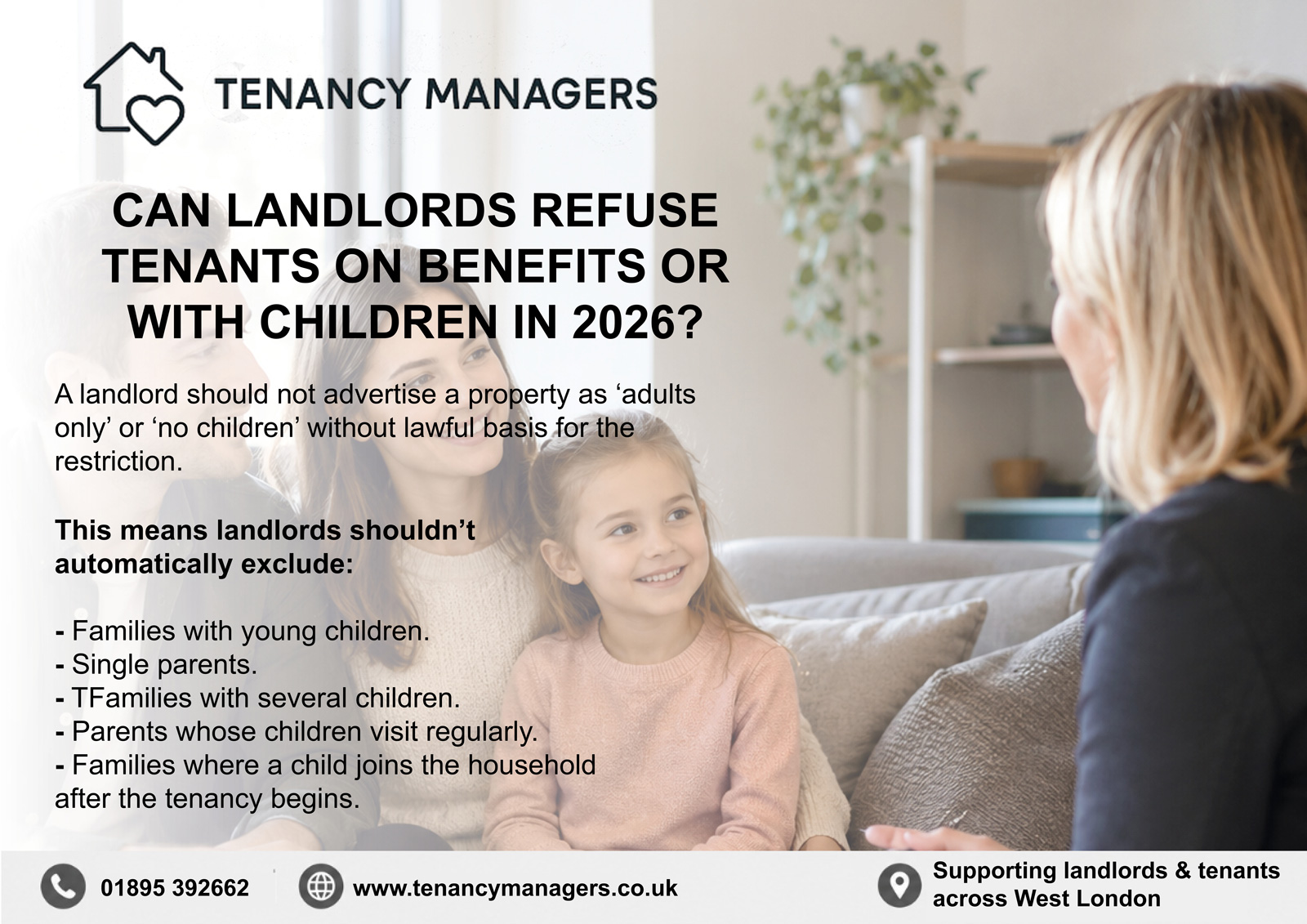
This means landlords should not automatically exclude:
- Families with young children
- Single parents
- Families with several children
- Parents whose children visit regularly
- Families where a child joins the household after the tenancy begins
A landlord should not advertise a property as “adults only” or “no children” without a lawful basis for the restriction.
Likewise, a letting agent should not prevent a family from arranging a viewing because the landlord would prefer a tenant without children.
However, there are limited circumstances in which a restriction relating to children may be lawful.
These can include genuine concerns about overcrowding, certain HMO licensing conditions, safeguarding risks or properties where the physical layout creates an identified safety issue that cannot reasonably be addressed.
The restriction must be a proportionate means of achieving a legitimate aim. A landlord cannot simply rely on a general preference for tenants without children.
For example, if a property cannot lawfully accommodate the proposed household because of a relevant occupancy limit, the landlord may have grounds to refuse that arrangement. They should establish the actual legal or safety issue rather than assuming that a family is unsuitable.
Official guidance: GOV.UK – If someone who has children wants to rent your property
What changed on 1 May 2026?
The Renters’ Rights Act 2025 introduced new protections against rental discrimination relating to children and benefits.
These rules apply to relevant private tenancies in England from 1 May 2026, including many existing tenancies.
The changes mean landlords and letting agents need to review how they advertise properties, assess applications and make decisions about prospective tenants.
|
Previous practice |
Position under the new rules |
|---|---|
|
Advertising a property as “no DSS” |
Generally prohibited where it excludes benefit claimants |
|
Ignoring Universal Credit during affordability checks |
Benefit income must be treated equally with other income |
|
Automatically rejecting families with children |
Generally prohibited, subject to limited lawful exceptions |
|
Refusing a viewing because someone receives benefits |
Generally prohibited |
|
Using a mortgage or lease restriction to exclude benefit claimants |
Such restrictions generally cannot be relied upon to justify discrimination |
|
Applying consistent affordability checks to all applicants |
Still permitted when applied fairly |
The legislation also addresses discriminatory restrictions in tenancy agreements, superior leases and mortgage arrangements. Insurance-related exceptions may apply temporarily in specific circumstances, so landlords should check the current rules rather than assume every historic contract term has the same effect.
For the full legal position, see the Renters’ Rights Act 2025.
Can landlords still carry out affordability checks?
Yes. Landlords can still assess whether a tenant can afford the rent.
The new rules do not require landlords to accept every applicant regardless of their financial circumstances.
However, the assessment must be fair and must not discriminate against people because they receive benefits or have children.
For example, a landlord may establish a reasonable income requirement and apply it consistently to all applicants.
When calculating an applicant’s income, the landlord must include relevant benefit income and treat it equally with other income.
Example: A tenant receiving Universal Credit
Imagine a property is advertised at £1,400 per month.
An applicant earns £1,000 per month from employment and receives £700 per month in benefits.
Their total monthly income is £1,700.
A landlord should not automatically disregard the £700 benefit income and assess the applicant as earning only £1,000.
Instead, the landlord should apply the same reasonable affordability criteria used for other applicants and consider the relevant income fairly.
The landlord may still refuse an applicant who genuinely fails to meet a consistently applied affordability requirement. However, they should not create a different or more demanding test simply because the person receives benefits.
What about a minimum salary requirement?
Landlords should be careful with minimum salary requirements that exclude benefit income or effectively disadvantage people who receive benefits.
A requirement that applicants must earn a certain amount from employment, for example, may create a discriminatory outcome if it ignores other income that should be taken into account.
A better approach is to establish a consistent affordability assessment based on the rent, the applicant’s relevant income and other legitimate financial considerations.
Keep a record of the criteria you use and how you applied them.
Can landlords still use tenant referencing?
Yes. Tenant referencing remains an important part of letting a property.
Landlords can still check relevant information to help assess an applicant’s suitability, including:
- Identity and right to rent, where applicable
- Employment and income
- Benefit income
- Credit history, where relevant and lawfully assessed
- Previous landlord references
- Rental payment history
- Ability to meet the proposed tenancy obligations
The important point is that these checks must be applied fairly.
A referencing provider should not automatically fail an applicant because they receive Universal Credit or another benefit.
Likewise, a landlord should not require a guarantor from benefit claimants as a blanket rule while allowing otherwise comparable employed applicants to proceed without one.
Any guarantor requirement should be based on consistent, legitimate criteria rather than benefit status itself.
Landlords should also ensure that any personal information collected during referencing is handled appropriately under data protection requirements.
Can landlords ask for a guarantor?
Landlords can still ask for a guarantor where there is a legitimate reason to do so.
For example, a guarantor may be considered where an applicant does not meet the landlord’s consistently applied affordability criteria.
However, requiring a guarantor solely because an applicant receives benefits could amount to unlawful discrimination.
The same applies if a landlord imposes a higher income threshold or extra conditions specifically on applicants receiving benefits.
A landlord should be able to explain why the requirement is necessary and show that it is applied consistently to applicants in comparable circumstances.
Where possible, use a clear written referencing policy so that decisions are based on the same standards.
Can a landlord's mortgage or insurance policy prevent tenants on benefits?
This is an area where landlords need to be particularly careful.
A landlord may have an older mortgage, superior lease or insurance policy that contains restrictions relating to tenants who receive benefits or have children.
However, the Renters’ Rights Act introduced rules that prevent many such restrictions from being relied upon to justify rental discrimination.
For relevant mortgage and superior lease terms, discriminatory restrictions generally ceased to have effect from 1 May 2026.
Insurance contracts have specific transitional rules. A qualifying insurance contract entered into before 1 May 2026 may fall within a limited exception until it ends or is renewed, depending on the circumstances.
For insurance contracts entered into or renewed after that date, discriminatory terms of the relevant kind generally cannot be relied upon.
Landlords should therefore speak to their insurer or mortgage provider if they are concerned about an existing clause.
Do not automatically reject a tenant because an older policy or agreement appears to restrict benefit claimants. Check whether the restriction remains legally effective and whether a specific exception applies.
Official guidance: GOV.UK – Rental discrimination under the Renters’ Rights Act 2025
Can landlords refuse families because of property size or safety?
In certain circumstances, a landlord may be able to restrict children living at a property where the restriction is a proportionate means of achieving a legitimate aim.
This is not a general exemption for landlords who prefer not to rent to families.
The landlord needs a genuine reason, and the restriction must be proportionate to that reason.
Relevant circumstances may include:
- Legal occupancy or overcrowding restrictions
- Certain HMO licensing conditions
- Genuine safeguarding concerns
- Specific physical hazards that cannot reasonably be mitigated
For example, a property may be subject to a licensing condition that prevents a particular household arrangement.
In another case, a specific feature of a property might create a demonstrable safety risk for a child that cannot reasonably be addressed.
The landlord should investigate the circumstances and consider whether a less restrictive solution is possible.
A general statement that a property is “not suitable for children” is not enough on its own.
Importantly, there is no equivalent general legitimate-aim exception allowing landlords to exclude benefit claimants simply because they receive benefits.
The rules concerning children and benefits are therefore not identical.
What are the penalties for rental discrimination?
Landlords and letting agents who breach the new rental discrimination rules may face enforcement action from their local authority.
Government guidance states that landlords can be fined up to £7,000 for each offence.
The exact outcome depends on the circumstances and the applicable enforcement provisions.
Examples of potentially discriminatory conduct include:
- Advertising a property as unavailable to benefit claimants
- Refusing to provide property information to a family because they have children
- Refusing a viewing because an applicant receives Universal Credit
- Ignoring benefit income during an affordability assessment
- Requiring a guarantor only because someone receives benefits
- Rejecting a family without a lawful and proportionate justification
Local authorities can investigate suspected breaches and take enforcement action where the legal requirements are met.
A landlord should not assume that a decision is lawful simply because a letting agent or referencing company made it on their behalf.
Landlords can be responsible for discriminatory conduct by people acting on their behalf.
Official guidance: GOV.UK – Enforcement measures for landlords under the Renters’ Rights Act
How can landlords protect themselves from discrimination claims?
The best approach is to establish a consistent, documented tenant selection process.
1. Review your property advertisements
Remove blanket statements such as “no DSS”, “no benefits” or “no children” unless a specific, legally justified exception has been established.
2. Use consistent affordability criteria
Set reasonable criteria based on the rent and apply them equally to all applicants.
Include relevant benefit income rather than automatically excluding it.
3. Review your referencing process
Check that any letting agent or referencing provider you use follows the new rules.
Make sure benefit income is treated fairly and that guarantor requirements are not imposed solely because of benefit status.
4. Assess property suitability objectively
If you believe a household cannot lawfully occupy a property, establish the actual reason.
Check occupancy limits, licensing conditions and any relevant safety issues before making a decision.
5. Keep written records
Record the criteria you applied, the information considered and the reason for your decision.
Avoid recording assumptions about an applicant based on their family circumstances or benefit status.
6. Review mortgage, lease and insurance terms
Check older restrictions with your provider and obtain advice if necessary.
Do not assume that a historic clause automatically permits you to exclude certain tenants.
7. Train anyone involved in letting your property
If you use a letting agent or third-party referencing company, make sure they understand the current requirements.
A compliant process should run consistently from the first enquiry through to the final tenancy decision.
How Tenancy Managers Can Help Landlords
Tenant selection remains important, but landlords now need to ensure that their decisions are fair, evidence-based and compliant with the law.
At Tenancy Managers, we help landlords manage the letting process, from tenant referencing and tenancy administration to rent collection and ongoing property management.
Our services include:
- Tenant referencing
- Fully Managed Lettings
- Rent Collection
- Property Management
- Maintenance Coordination
- Rent Arrears Management
- Compliance Support
- Rent Guarantee Insurance, subject to applicable policy terms and eligibility requirements
We support landlords across Harrow, Uxbridge, Hillingdon and West London.
If you are unsure whether your current tenant selection process meets the latest requirements, we can discuss your property management arrangements and explain how our services may help.
Contact Tenancy Managers on 01895 392662 to discuss your rental property.
Frequently Asked Questions
Can landlords refuse tenants on benefits in 2026?
Generally, no. Landlords in England must not refuse or disadvantage prospective tenants because they receive benefits. They can still assess affordability, provided benefit income is treated fairly and equally with other income.
Can a landlord refuse someone receiving Universal Credit?
A landlord cannot automatically refuse someone because they receive Universal Credit. They can assess whether the applicant can afford the rent using consistent criteria that include relevant benefit income.
Can landlords refuse tenants with children?
Generally, no. Landlords cannot refuse applicants simply because they have children. Limited exceptions may apply where a restriction is a proportionate means of achieving a legitimate aim, such as complying with certain occupancy or licensing requirements.
Can a landlord ask for a guarantor if a tenant receives benefits?
A landlord may ask for a guarantor where justified by consistently applied criteria. Requiring one solely because an applicant receives benefits may be discriminatory.
Can landlords still carry out credit checks?
Yes. Relevant credit checks and other lawful referencing checks can still form part of the application process, provided they are used fairly and consistently.
Does the law apply to existing tenants?
The new rental discrimination protections apply to relevant existing and prospective private tenants from 1 May 2026. Landlords should review existing tenancy terms and practices as well as their approach to new applications.
Can landlords refuse children because a property is small?
Possibly, where there is a genuine occupancy or overcrowding issue and the restriction is legally justified. Landlords should check the relevant requirements rather than impose a blanket ban on children.
What is the fine for refusing a tenant on benefits?
Government guidance states that a landlord can be fined up to £7,000 for each offence. The applicable outcome depends on the circumstances and the enforcement process.
Do the rules apply throughout the UK?
The measures discussed in this article apply to relevant private rented tenancies in England. Different legislation and procedures may apply in Wales, Scotland and Northern Ireland.
Final Thoughts
The Renters’ Rights Act has changed how landlords in England must approach tenant selection.
Landlords can still assess affordability, carry out appropriate referencing and ensure that a property is suitable for the proposed household.
However, they must not automatically exclude applicants because they receive benefits or have children.
The safest approach is to use consistent affordability criteria, treat all relevant income fairly, assess property suitability objectively and keep clear records of decisions.
If you need help managing your rental property and navigating changing landlord responsibilities, Tenancy Managers can help.
Call 01895 392662 to discuss property management across Harrow, Uxbridge, Hillingdon and West London.