


The Renters’ Rights Act has changed how private landlords in England increase rent. Find out what Form 4A is, when to use it, how much notice to give tenants and what happens if a tenant challenges a proposed increase.
If you are a private landlord in England and want to increase the rent on your property, you need to understand the new rules introduced by the Renters’ Rights Act 2025.
Since 1 May 2026, landlords have had to follow the updated Section 13 rent increase process for most assured periodic tenancies. This means using Form 4A: Landlord’s Notice Proposing a New Rent, rather than relying on an informal letter or a rent review clause in an old tenancy agreement.
Getting the process wrong could delay your proposed rent increase and create avoidable disputes with your tenant.
In this guide, Tenancy Managers explains what Form 4A is, how it works and what landlords should do before serving a rent increase notice.
What Is Form 4A?
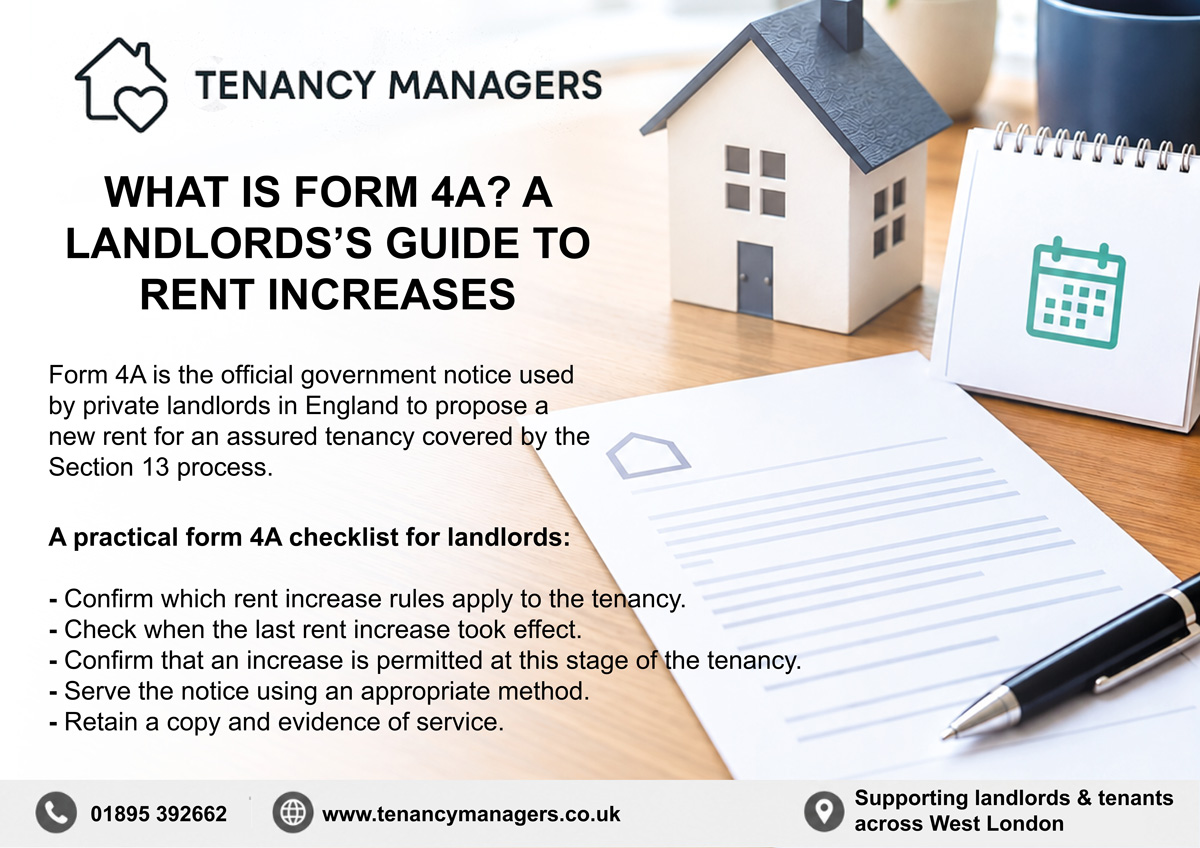
Form 4A is the official government notice used by private landlords in England to propose a new rent for an assured tenancy covered by the Section 13 process.
It was introduced as part of the changes under the Renters’ Rights Act, which came into force on 1 May 2026.
The form formally tells your tenant:
- The current rent arrangement is changing.
- The new rent you are proposing.
- The date you want the new rent to start.
- How the tenant can respond if they disagree with the proposed increase.
- How they can challenge the proposed rent through the First-tier Tribunal (Property Chamber).
The important point is that Form 4A is not simply a rent increase letter. It is the prescribed legal notice that landlords generally need to use to increase rent under the new rules.
You can find the official form on the government website:
Download Form 4A – Landlord’s Notice Proposing a New Rent
Why Has Form 4A Become Important?
Before the Renters’ Rights Act changes, landlords could use different approaches to increasing rent, depending on the tenancy agreement and the circumstances.
The new system introduces a more consistent process for most private assured periodic tenancies.
Under the updated rules:
- Landlords must generally use Form 4A to propose a rent increase.
- At least two months’ notice must be given.
- Rent cannot normally be increased more than once in a 12-month period.
- Rent cannot be increased during the first year of the tenancy.
- Tenants can challenge a proposed increase if they believe it exceeds the open market rent.
These requirements apply to private rented properties in England covered by the new rules. Different arrangements apply to some other types of tenancy, including social housing.
Official guidance is available here:
Renters’ Rights Act: An Overview for Landlords
When Do Landlords Need to Use Form 4A?
If you want to increase the rent on a property let under an assured periodic tenancy in the private rented sector in England, you will generally need to use Form 4A.
This applies even if you have already discussed the proposed increase with your tenant and they have indicated that they are happy with it.
You should still follow the formal Section 13 process.
For example, imagine you currently rent out a property in Uxbridge for £1,500 per month and believe the market rent has increased.
You discuss the proposed increase with your tenant, who agrees in principle to a new rent of £1,575 per month.
Rather than simply confirming the change by email, you should follow the prescribed process and serve a correctly completed Form 4A.
This helps ensure that the increase is handled in accordance with the applicable legal requirements.
Remember: an informal agreement does not remove the requirement to follow the formal process where Section 13 applies.
How Much Notice Must a Landlord Give Using Form 4A?
Landlords must generally give their tenants at least two months’ notice before a proposed rent increase can take effect.
This means you need to plan rent reviews in advance rather than expecting an increase to take effect immediately.
Example of a Form 4A rent increase
Suppose you want a new rent to begin on 1 February 2027.
You would need to serve the notice sufficiently early to provide the full required notice period. You should check the dates carefully before serving the form.
When calculating the date, allow at least two full months between service of the notice and the proposed start date. Also check that the increase complies with the rules governing the date of the last increase.
Do not assume that sending a notice on the last day of a month will automatically make an increase valid from a particular date.
The prescribed form contains guidance on the proposed start date, and the government provides further information here:
Official guidance on rent increases
Can Landlords Increase Rent Whenever They Want?
No. The new rules place restrictions on how frequently rent can be increased.
For most private assured periodic tenancies covered by the new rules:
- Rent can generally be increased only once every 12 months.
- Rent cannot be increased during the first year of the tenancy.
- The correct notice process must be followed.
- The proposed rent must comply with the rules governing open market rent.
For example, if a rent increase took effect on 1 November 2026, the next increase could not normally take effect before 1 November 2027.
This remains relevant even if the landlord believes local rental values have increased significantly during that period.
Landlords should keep clear records of previous rent increases, including the date each increase took effect.
How Much Can a Landlord Increase Rent Using Form 4A?
There is no universal percentage increase that automatically applies to every rental property.
The proposed rent must comply with the applicable rules, including the requirement that it should not exceed the property's open market rent.
Open market rent is broadly the rent that could reasonably be expected if the property were let on the open market.
This means landlords should avoid choosing an arbitrary increase without considering comparable properties and local market conditions.
How to assess the appropriate rent
Before proposing an increase, consider:
1. Comparable properties
Look at similar properties currently available to rent in the same area.
2. Property size and layout
The number of bedrooms, floor area and overall layout can influence rental value.
3. Property condition
A well-maintained property may attract a different rent from one requiring substantial repairs or modernisation.
4. Location and amenities
Transport links, local facilities, parking, outdoor space and other amenities can affect what tenants are willing to pay.
5. Recent rental evidence
Where possible, use reliable evidence of rents achieved for comparable properties, rather than relying only on advertised asking prices.
For landlords in Harrow, Uxbridge, Hillingdon and West London, this local assessment can be particularly important because rental values can vary considerably between neighbourhoods and property types.
A realistic rent based on market evidence can help reduce the likelihood of a dispute.
What Information Does Form 4A Include?
Form 4A is a prescribed document and should be completed carefully.
It includes information such as:
- The tenant or tenants named on the notice.
- The address of the rental property.
- The landlord's name and contact address.
- The existing rent and proposed new rent.
- The date on which the proposed new rent is intended to begin.
- Information explaining the tenant's options if they disagree.
If the property has a joint tenancy, make sure the relevant tenant details are completed correctly.
You should also check that the proposed rent and start date are accurate and comply with the relevant requirements.
Do not rewrite the official form or remove its wording. Government guidance states that prescribed forms should not be altered unless the form itself allows it, as changes could affect validity.
You can access the current version through the official assured tenancy forms page.
How Should a Landlord Serve Form 4A?
Completing the form correctly is only part of the process. You must also serve it appropriately and be able to demonstrate that you did so.
The official Form 4A guidance explains that landlords should follow any agreed service arrangements in the written tenancy agreement.
Where the agreement does not specify how notices should be served, the form provides for methods including handing the notice to the tenant in person, leaving it at the tenant's address or sending it by registered post.
Email may be appropriate where the tenancy agreement allows notices to be served in that way.
Before sending the notice:
- Check the tenancy agreement's notice and service provisions.
- Confirm the tenant and property details.
- Check the proposed rent and start date.
- Allow the full notice period.
- Keep a copy of the completed form.
- Retain evidence of when and how the notice was served.
Do not assume that an email has been validly served simply because it was sent. Check the applicable service requirements and retain suitable evidence.
What Happens If a Tenant Disagrees with Form 4A?
A tenant does not necessarily have to accept a proposed rent increase simply because the landlord has served the notice.
If the tenant believes the proposed rent is above the open market rent, they can apply to the First-tier Tribunal (Property Chamber) for a determination.
The tribunal considers what the open market rent should be for the property.
Depending on its assessment, the tribunal may determine a rent that is lower than, equal to or otherwise different from the amount proposed by the landlord.
This is why it is important to have evidence supporting the proposed rent.
What should landlords do if a tenant challenges the increase?
If your tenant disputes the proposed increase:
- Stay professional and keep communication in writing.
- Review the evidence you used to calculate the proposed rent.
- Keep records of comparable properties and relevant rental evidence.
- Check the notice and any correspondence carefully.
- Seek professional advice if you are unsure how to respond.
You can find further information here:
Apply for an open market rent determination – GOV.UK
Landlords should not assume that a tenant's challenge can simply be ignored. Equally, a tenant should not assume that every proposed increase will automatically be rejected.
The outcome depends on the applicable rules and the evidence considered.
What Happens If a Landlord Uses the Wrong Form?
Using the wrong form or failing to comply with the prescribed requirements can create problems for a landlord.
For example, a notice may be challenged if it does not meet the legal requirements, contains incorrect information or proposes an invalid start date.
If the notice is not valid, the landlord may need to correct the issue and serve a new notice, potentially delaying the proposed increase.
Common mistakes include:
- Using an outdated form.
- Using Form 4 instead of Form 4A for a private rental where Form 4A is required.
- Giving less than the required notice.
- Proposing an increase too soon after the previous increase.
- Entering incorrect tenant or property details.
- Using an inappropriate service method.
- Failing to retain evidence of service.
- Proposing a rent without considering the open market.
If you are unsure whether a notice has been completed correctly, seek appropriate advice before relying on it.
Does Form 4A Apply to Existing Tenants?
Yes, the new rent increase process is relevant to many existing private tenancies as well as new tenancies.
From 1 May 2026, most existing assured shorthold tenancies in the private rented sector became assured periodic tenancies under the Renters’ Rights Act.
Landlords must therefore consider the new rules when reviewing rents for existing tenants.
However, transitional arrangements can apply to rent increase notices served before 1 May 2026.
For example, a valid notice served using the previous Form 4 before the changes took effect may continue to apply according to its terms. The timing of the previous increase also matters when calculating when another increase can take effect.
If you served a notice before the legislation changed, check the official transitional guidance rather than assuming the new rules automatically cancel it.
Further information is available in the government's guidance on rent increases.
Can a Landlord Still Use a Rent Review Clause?
Landlords should not assume that an existing rent review clause in a tenancy agreement allows them to bypass the new statutory process.
For most private assured periodic tenancies covered by the new rules, the Section 13 process must be followed when increasing rent.
The government also explains that certain rent increases agreed before 1 May 2026 under a rent review clause but intended to take effect after that date will not apply under the transitional rules.
If you have an older tenancy agreement containing a rent review clause, check the current guidance before relying on it.
This is especially important where a landlord has previously used contractual rent reviews rather than statutory notices.
A Practical Form 4A Checklist for Landlords
Before proposing a rent increase, work through the following checklist.
Confirm which rent increase rules apply to the tenancy.
Check when the last rent increase took effect.
Confirm that an increase is permitted at this stage of the tenancy.
Research comparable properties and establish a reasonable market rent.
Discuss the proposed increase with the tenant where appropriate.
Download the current official Form 4A.
Complete the form accurately.
Check that the proposed start date allows the required notice period.
Serve the notice using an appropriate method.
Retain a copy and evidence of service.
Keep a record of the proposed rent and effective date.
Respond appropriately if the tenant raises a dispute.
Following a consistent process can help landlords avoid preventable administrative mistakes.
How Can a Letting Agent Help with Rent Increases?
Managing rent increases involves more than deciding how much additional rent to charge.
Landlords also need to monitor market conditions, check the timing of previous increases, understand the current legislation, complete the correct documentation and communicate with tenants.
A professional letting agent can help coordinate these steps.
At Tenancy Managers, we help landlords manage their properties and navigate the changing requirements of the private rented sector.
Our services include:
- Rent reviews and rent collection.
- Tenant referencing.
- Tenancy administration.
- Property management.
- Maintenance coordination.
- Rent arrears monitoring.
- Compliance support.
- Rent Guarantee Insurance, subject to the applicable policy terms and eligibility requirements.
For landlords who would prefer professional support, having a structured management process can make it easier to keep track of rent reviews and other responsibilities.
We work with landlords across Harrow, Uxbridge, Hillingdon and West London.
Need help managing a rent increase?
Contact Tenancy Managers on 01895 392662 to discuss your property management requirements.
Frequently Asked Questions About Form 4A
What is Form 4A in renting?
Form 4A is the prescribed notice private landlords in England generally use to propose a new rent for an assured tenancy covered by the Section 13 process.
Is Form 4A compulsory for landlords?
For most private assured periodic tenancies covered by the new rules, yes. Landlords must generally use Form 4A even if the tenant has already agreed to the proposed increase.
How much notice does Form 4A give a tenant?
Landlords must generally provide at least two months' notice before the proposed increase takes effect.
Can I increase rent without Form 4A?
If the tenancy is covered by the Section 13 process, you should not bypass the prescribed notice by relying on an informal letter or an agreement with the tenant. Check the applicable rules and any transitional arrangements.
How often can a landlord increase rent in 2026?
For most private assured periodic tenancies, rent can generally be increased only once every 12 months and not during the first year of the tenancy.
Can a tenant refuse a Form 4A rent increase?
A tenant can challenge a proposed increase if they believe it exceeds the open market rent. The First-tier Tribunal (Property Chamber) can determine the appropriate rent. A tenant's disagreement does not automatically mean that the proposed rent is invalid.
Can a landlord increase rent by 10%?
There is no universal 10% limit or automatic entitlement to increase rent by that amount. The proposed rent must comply with the applicable rules, including the open market rent requirement.
Where can I download Form 4A?
You can download the official form from the government's Assured tenancy forms page.
Does Form 4A apply throughout the UK?
The Form 4A process described in this guide applies to relevant private rented tenancies in England. Different legislation and procedures apply in Wales, Scotland and Northern Ireland.
Final Thoughts
Form 4A is now a key part of the rent increase process for private landlords in England.
Since the Renters’ Rights Act changes took effect on 1 May 2026, landlords need to pay closer attention to the timing of rent reviews, the notice they serve and the evidence supporting their proposed rent.
The safest approach is to check the current rules, assess the local market carefully, use the correct form and keep clear records.
If you are unsure how to manage a rent increase or want help with the wider responsibilities of being a landlord, Tenancy Managers can help you understand your property management options.
Contact Tenancy Managers today on 01895 392662 to discuss managing your rental property across Harrow, Uxbridge, Hillingdon and West London.